Quantum
Snakes & Ladders
The Institute for Fundamental Study
Quantum
Snakes & Ladders
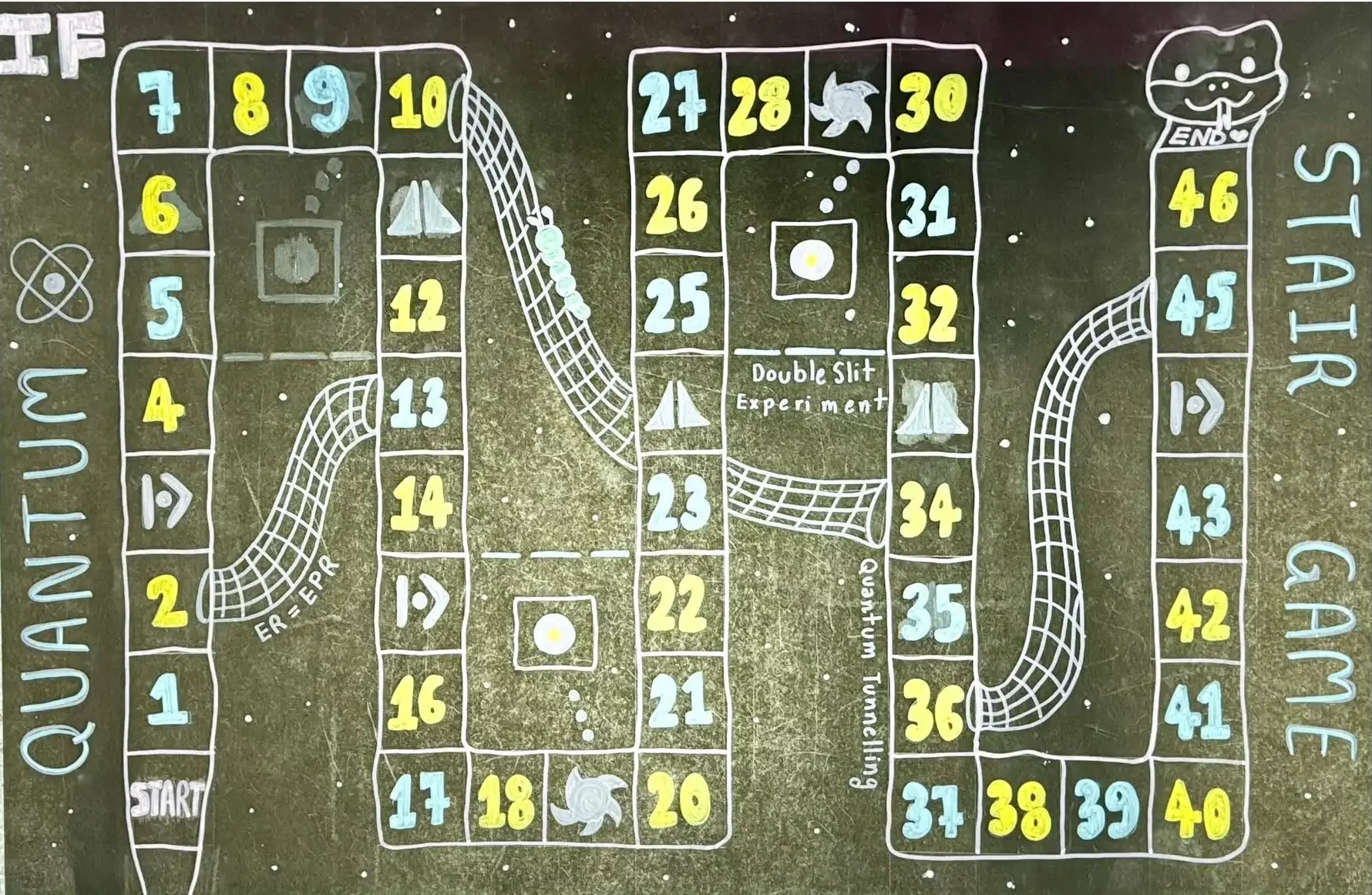
Integrating quantum effects into board game mechanics to make advanced science, such as quantum physics, much more accessible to young learners.
Original Hand-Drawn Blueprint
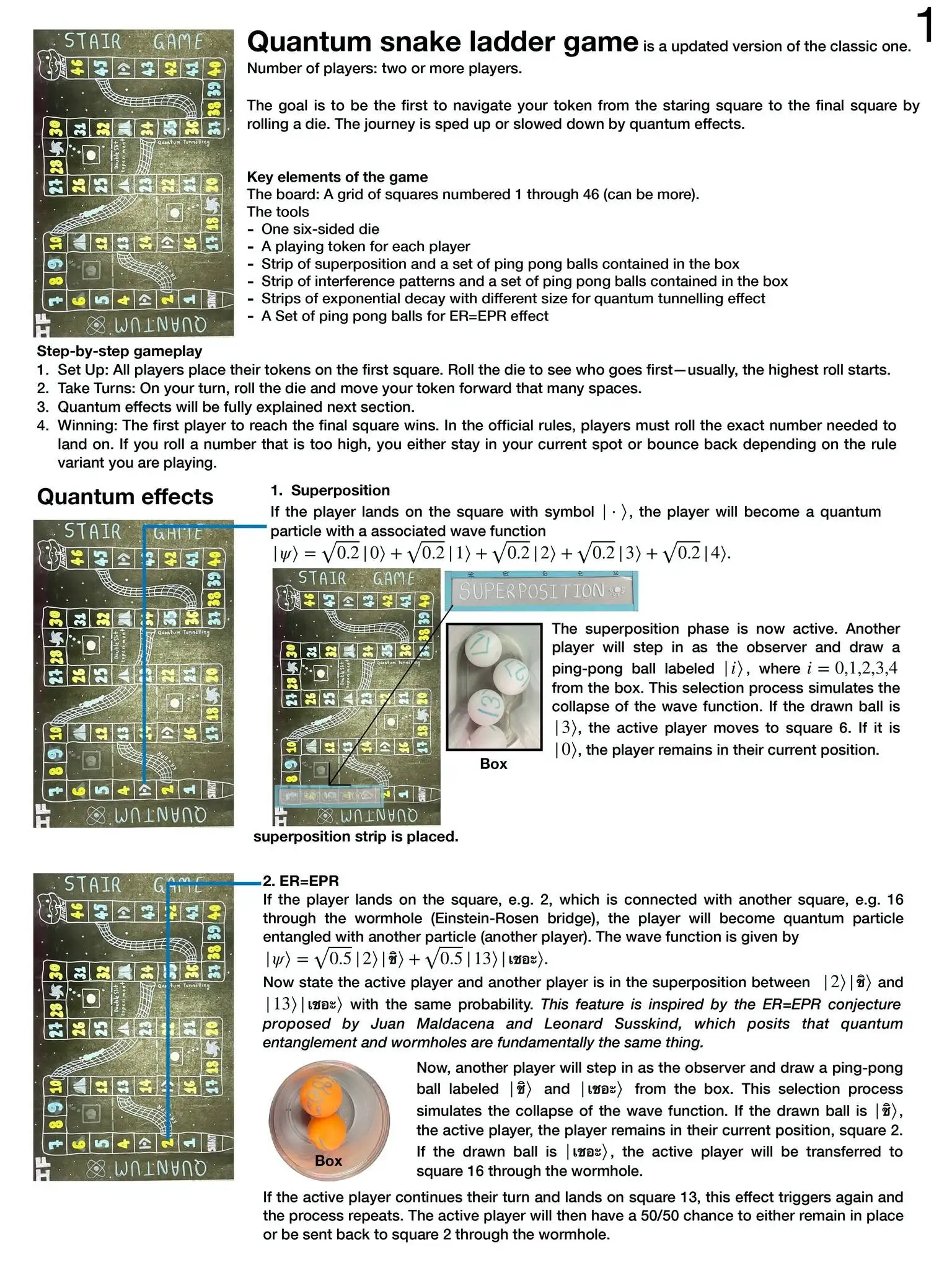
Examine the original hand-drawn board design and physical game mechanics developed for the Quantum Snakes & Ladders game.
Core Game Loop
Tools & Components
Standard 6-Sided Die
Generates baseline kinetic motion.
Superposition Kit
Superposition strip + 5 ping-pong balls in a closed box.
Double-Slit Effect
Interference pattern + a set of coloured ping-pong balls in a closed box.
Quantum Tunnelling
Segmented exponential drop strips indicating spatial transmission ratios through high-potential walls.
ER = EPR
Non-local wormhole for teleportation between the initial point and the final point + 2 ping-pong ball in a closed box.
PEDAGOGICAL CORE MECHANICS
4 Quantum
Phenomena
In Action & Simulation
Each mechanic translates key quantum concepts into tactile gameplay and physical random sampling.
Superposition &
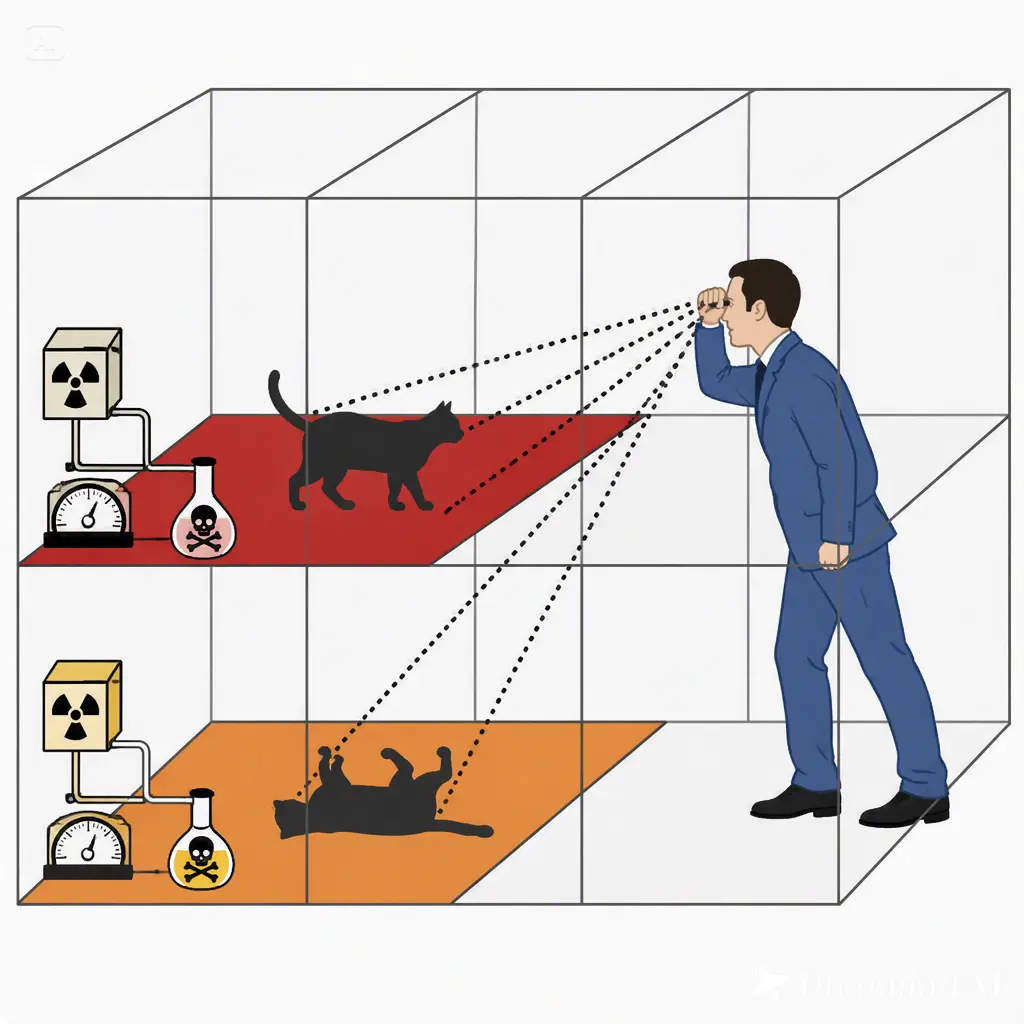
Wave Function Collapse
When the player lands on the square marked with the ket symbol |·⟩, the player becomes a quantum particle with an associated wave function. Another player acts as the Observer and draws one of five numbered ping-pong balls from the box to simulate the collapse of the wave function.
ER = EPR
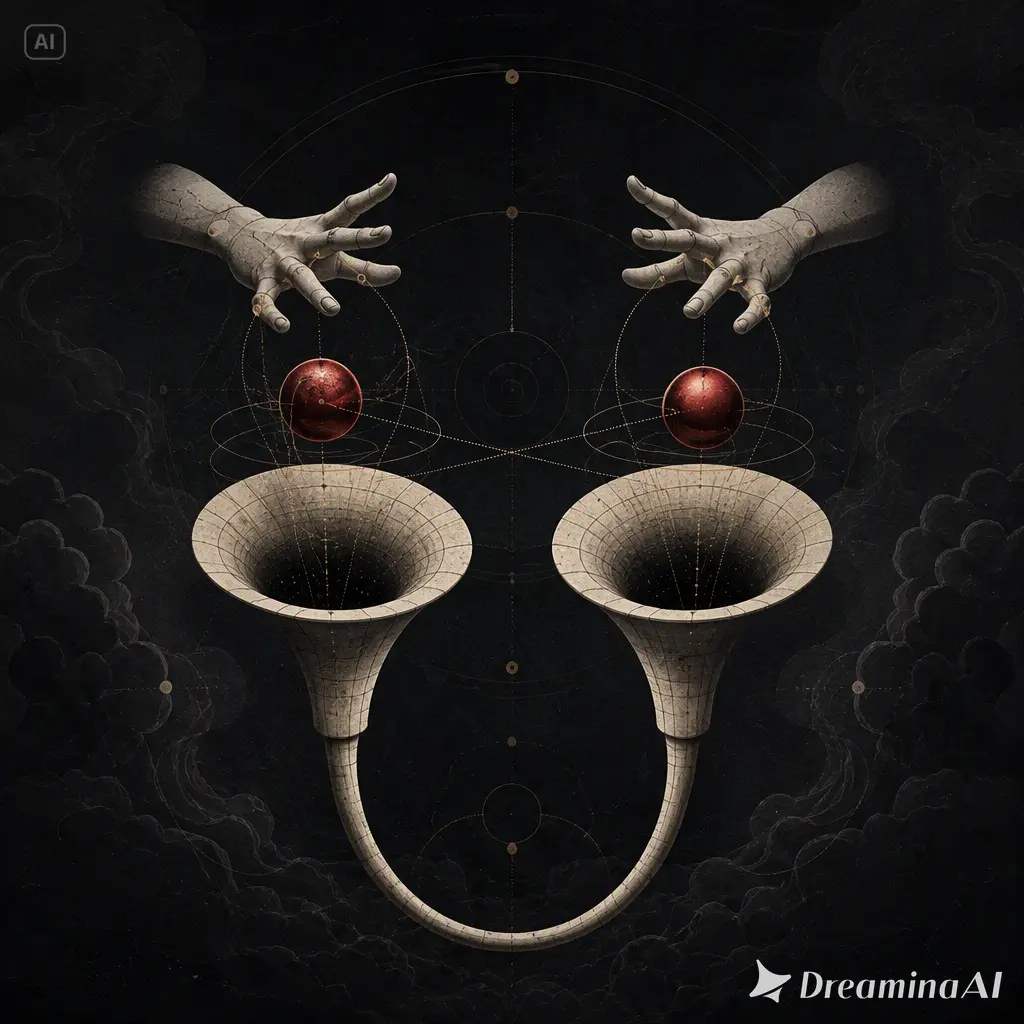
Spacetime Wormholes
Grounded in the Maldacena-Susskind conjecture linking Einstein-Rosen bridges with quantum entanglement. Landing on an entangled square gives you a 50/50 chance to either stay or teleport instantaneously through hyperspace!
Double-Slit
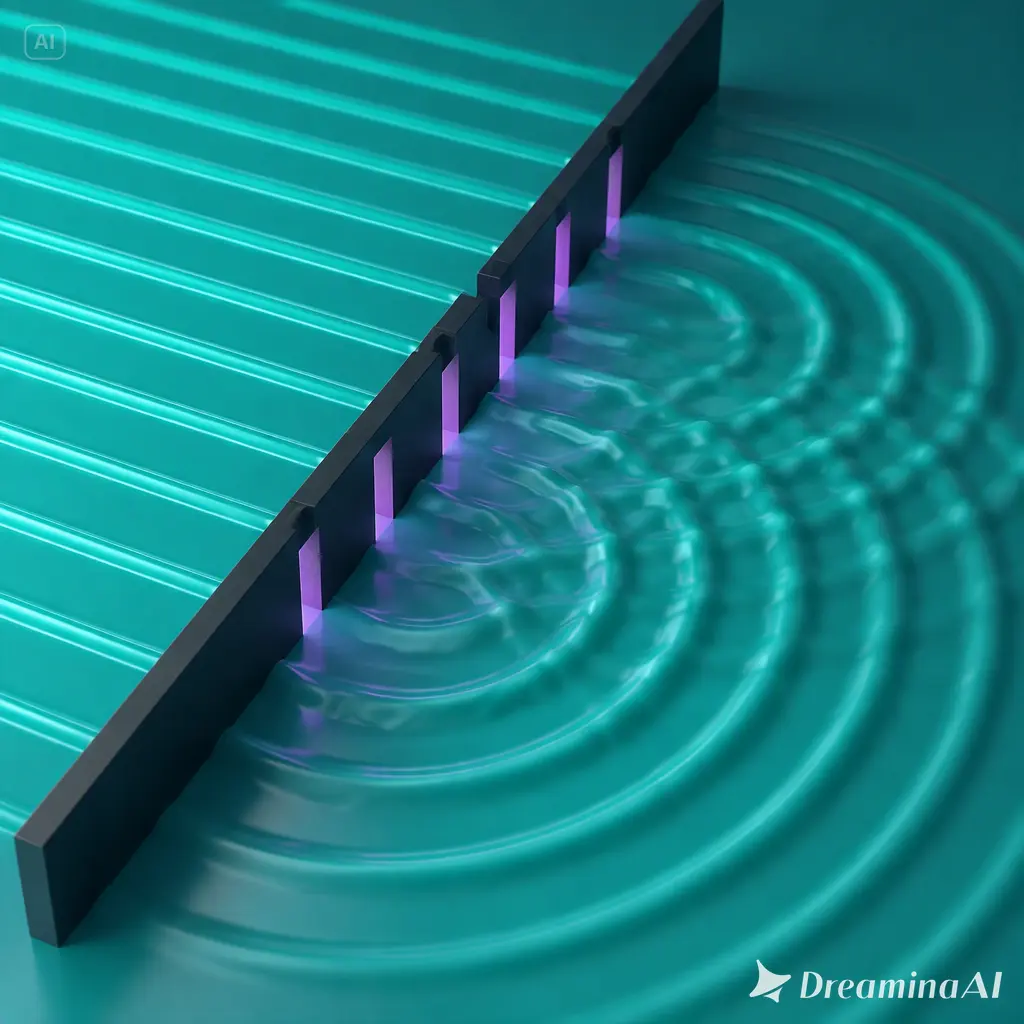
Interference Patterns
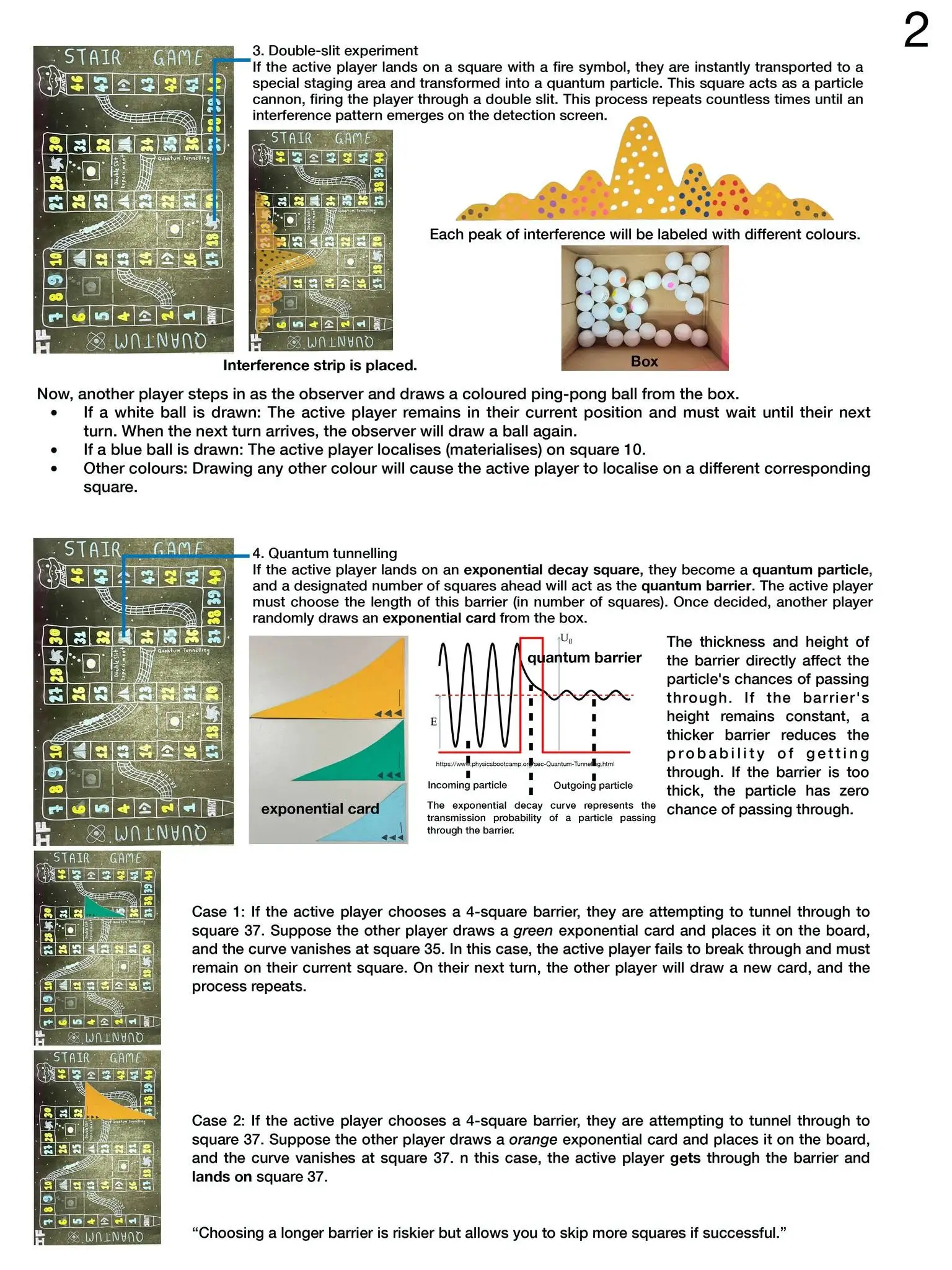
If the active player lands on a square with the fire symbol, the player is transported to a staging area and transformed into a quantum particle. The particle is then fired through a double slit, with repeated trials producing an interference pattern.
Another player acts as the Observer and draws a coloured ping-pong ball. The colour determines the player’s next materialisation point.
- White ball: The player remains in their current position and waits until the next turn.
- Blue ball: The player materialises on square 10.
- Other colours: The player materialises on the corresponding square.

Potential Barrier &
Quantum Tunnelling
When the active player lands on an exponential decay square, the player becomes a quantum particle. A designated number of squares ahead acts as the quantum barrier.
The player chooses the barrier length, and another player randomly draws an exponential card from the box to determine whether tunnelling succeeds.
The thickness and height of the barrier affect the particle’s chance of passing through. A thicker barrier reduces the probability of transmission. Choosing a longer barrier is riskier but allows the player to skip more squares if successful.
GAME DOCUMENTATION & RULE SPECIFICATIONS
Game rules and design documentation covering quantum effects, observer sampling mechanics, and board layout.
Outreach Context & Awards
Developed for youth and university physics outreach by the Institute for Fundamental Study (IF), Naresuan University.

Teaching and Learning
Strategy of the Year
Awarded Winner in the NU Star Awards 2026 to promote academic excellence and push outstanding works to the international stage at THE Awards Asia 2027.

Collaborative Educational Inquiry
Bringing cutting-edge theoretical physics down from abstract chalkboards into interactive classroom gaming workshops.
Impact &
Outreach
Educational
Impact Analysis
Adapting classic board game mechanics serves as a powerful, intuitive tool to teach deep quantum physics concepts to a broad audience in Thailand.
Demystifying Frontier Science
Translates abstract mathematical formulas into concrete physics mechanisms (e.g., wormholes for ER=EPR and color-coded draws for Superposition). This builds concrete intuition before secondary students face complex linear algebra.
Bridging Conceptual Visualization
Replaces static 2D plots with physical experimentation. Allows undergraduate STEM students to interactively evaluate exponential decay behaviors and quantum tunnelling mechanics, bridging the gap from classical intuition to quantum reality.
National Quantum Workforce Goals
Acts as an early-funnel talent attractor aligning with Thailand’s strategic deep-tech investments. Inspiring secondary students through gamified physics fosters early interest to feed the emerging quantum and deep-tech sectors.
Low-Cost EdTech Deployment
Relies on simple, low-cost physical components. Allows rural or underfunded educational zones across Thailand to adopt hands-on quantum educational tools without requiring expensive software, hardware, or high-speed internet.
Active Learning & Collaborative Inquiry
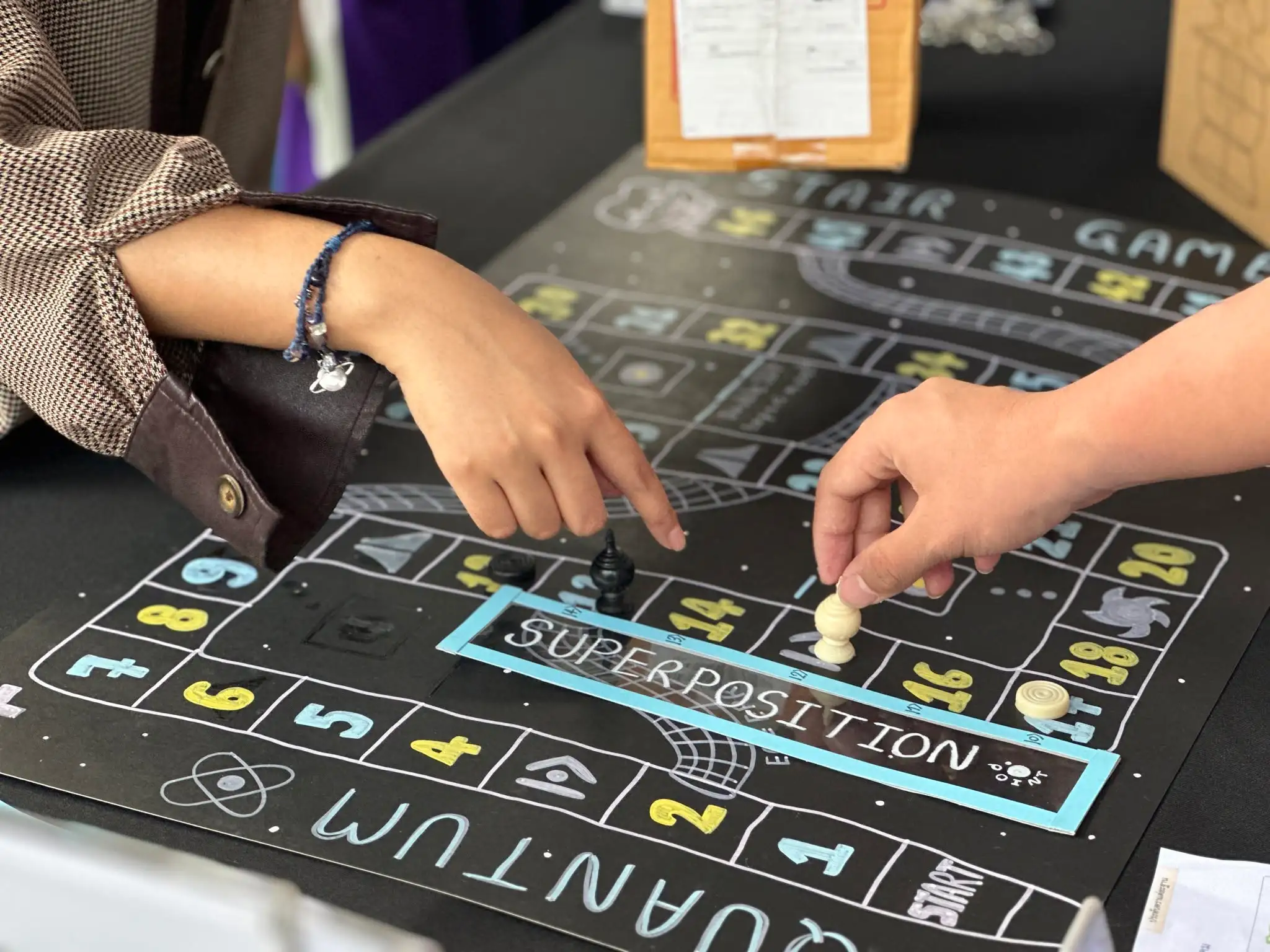
Shifts away from traditional passive lectures. The dynamic gameplay requires players to act as the “Observer” to collapse wave functions, directly gamifying measurement theory while forcing active peer interaction and problem-solving.
International
Impact Dimensions
Scaling the quantum pedagogy framework to a global audience, bridging the gap for developing nations and future workforces.
Contribution to the Quantum Movement
By retooling a globally ubiquitous classic game with quantum mechanics, this project lowers the cognitive bar. It offers a plug-and-play framework for educators worldwide to explain complex phenomena without expensive equipment.
Standardizing Low-Cost Pedagogy
Serves as an open-access model for “unplugged” physics education. It establishes a scalable blueprint for STEM education across Latin America, Africa, and Southeast Asia using simple everyday objects.
Physics Education Research (PER)
Broad adoption allows researchers at the Institute for Fundamental Study (IF) to collect empirical data across diverse demographics, publishing high-impact PER papers and establishing the creators as global pioneers.
Strategic Scientific Diplomacy
Elevating a Thai-designed physics game to global STEM fairs and international science centers positions Thailand as a forward-thinking innovator in deep-tech education, building cross-border academic partnerships.
Early-Funnel Workforce Pipeline
Exposing K-12 students globally to quantum concepts during formative years builds early confidence and removes the psychological barrier to entering quantum computing, engineering, and physics careers.